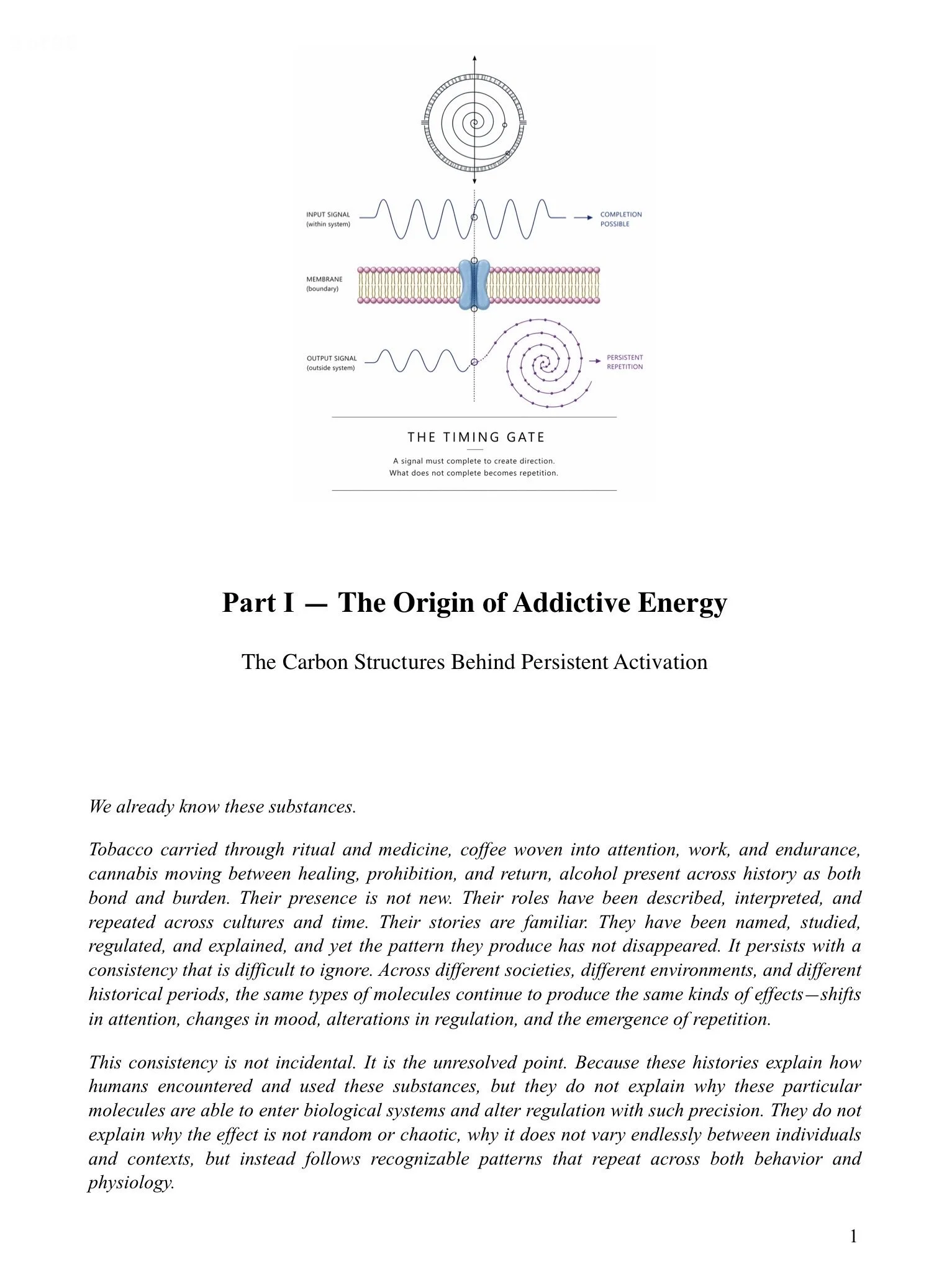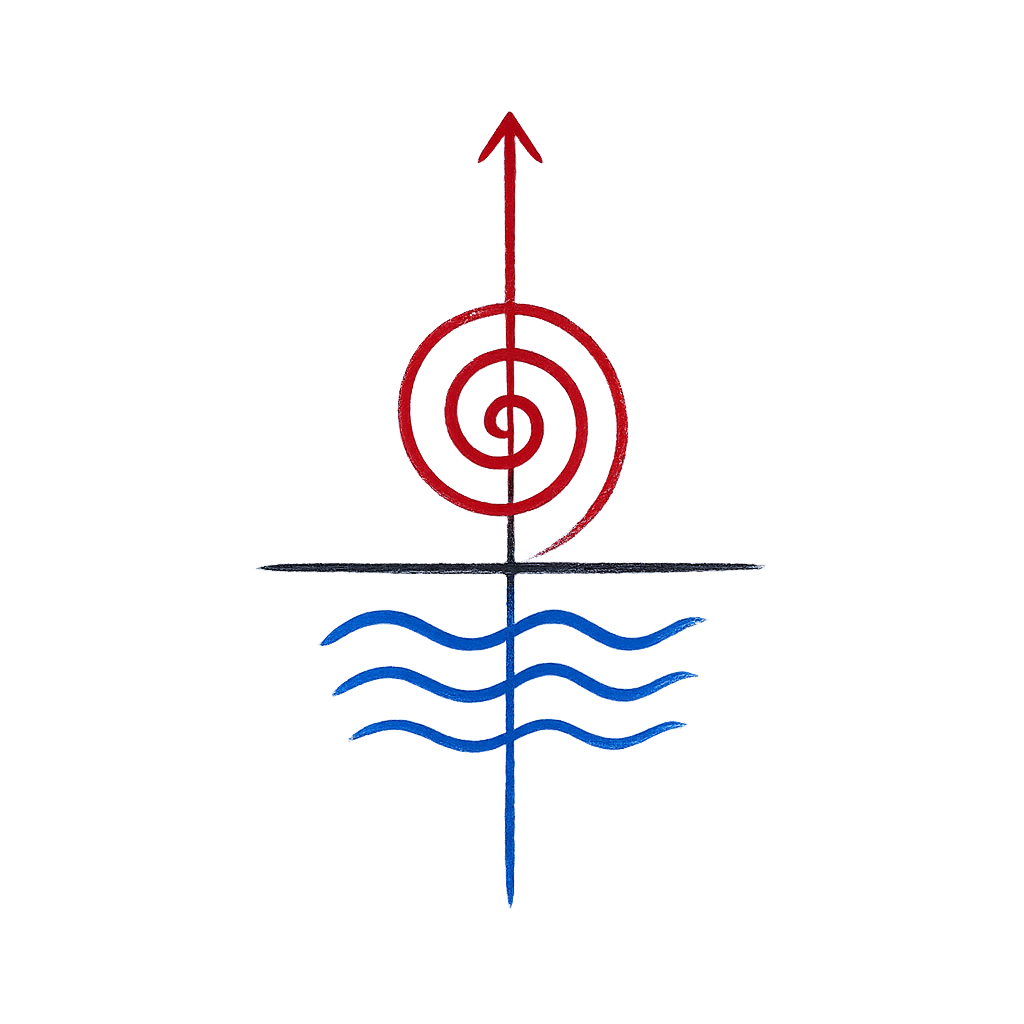

The Dormant People logo represents entrainment — when external rhythms override biological timing. Repeated stimulation pulls the nervous system out of completion. The body stays active but cannot resolve.
Dormant does not mean inactive. It means potential held in suspension. This work is about restoring timing.
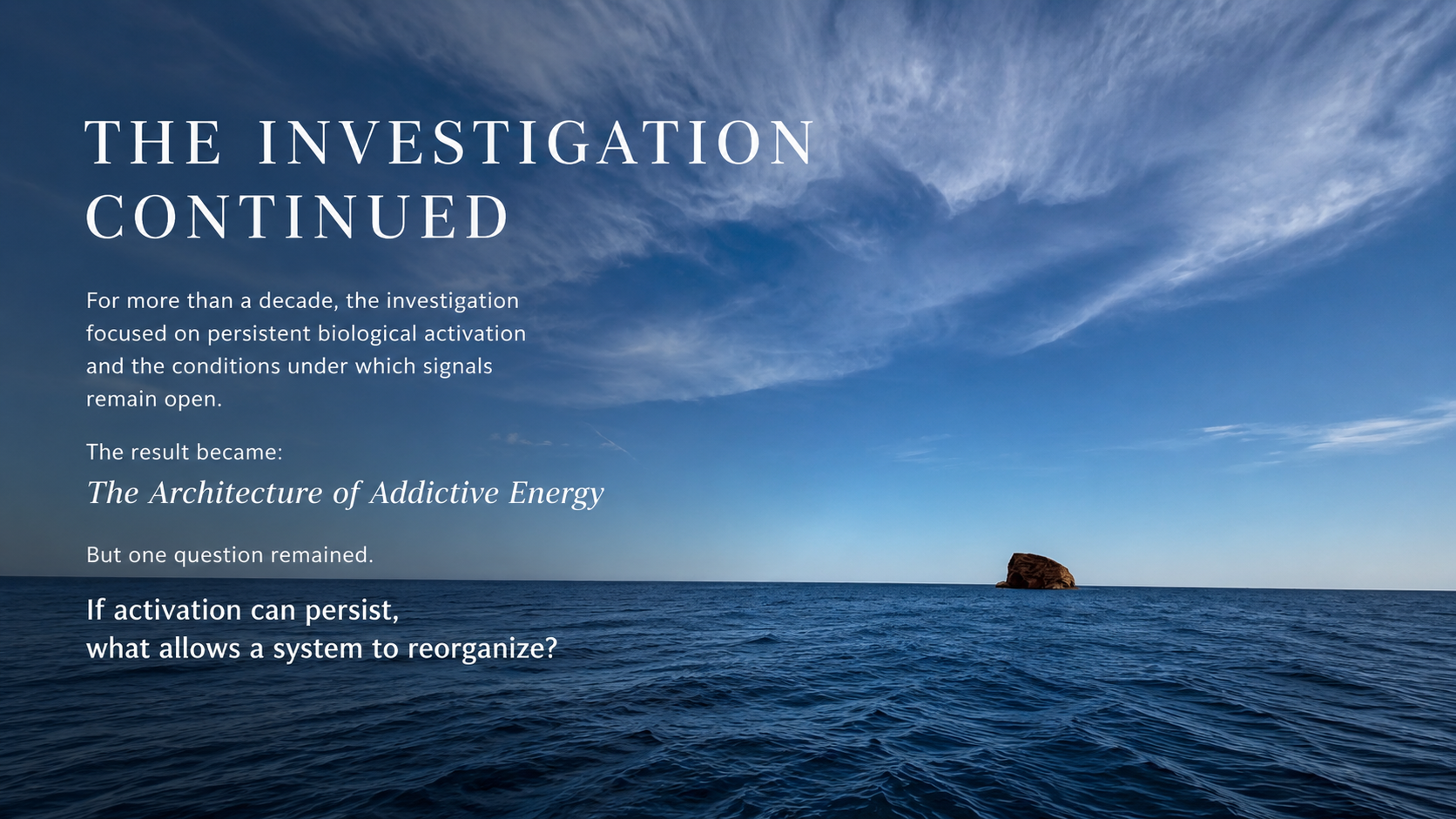
I Discovered Why and How We Use Our Most Powerful Energy as Addiction
A living system is not primarily a thinking system. It is also a stabilizing system. Before there can be thoughts, images, imagination, or meaning, something more fundamental must occur: the organism must be able to complete activation and return to rest.
Perception does not begin in the brain. Perception begins in geometry. Every experience follows a biological sequence: stimulus → signal → mineral shaping → carbon form → hydrogen discharge → reset → perception
When this sequence completes, awareness is clear. When it is interrupted, the system does not simply become “stimulated.” It becomes trapped in unfinished activation. This unfinished state is what modern life continuously produces.
Stimulus and signal: activation enters the body
Every addictive process begins the same way: something enters the system. It may be nicotine, caffeine, alcohol, cannabis, pharmaceuticals, sugar, flavor enhancers, preservatives, fragrances, cleaning agents, plastics, petroleum vapors, screens, or emotional pressure. All of these act as stimuli. The body converts stimulus into signal: electrical shifts, receptor activation, neurotransmission, metabolic mobilization. Signal means energy is now moving. But signal alone is not enough. Signal must be shaped.
Mineral shaping: where biological geometry is formed
Before carbon can organize into meaningful structure, minerals must first establish spatial order. Potassium, magnesium, manganese, chloride, bicarbonate, iron, and related ions provide:
polarity
orientation
conductivity
binding capacity
lattice stabilization
They create the resting geometry that allows biological form to exist. This is not metaphor. Minerals define how charge moves, how membranes hold, how receptors align, how tissues maintain coherence. Without sufficient mineral shaping, activation remains diffuse. The signal cannot find a stable configuration. The system becomes electrically and chemically noisy. This is where modern physiology begins to fracture. Because most addictive substances do not support mineral shaping. They bypass it.
Carbon form: when carbon follows geometry — or overrides it
Carbon is life’s building material. But carbon is not intelligent on its own. It must follow a template. In healthy biology, carbon takes shape inside mineral geometry. Membranes, enzymes, signaling molecules, and tissues emerge only after minerals have stabilized space. But modern addictive substances deliver carbon in a very different way. They arrive as methylated molecules and long carbon chains. This includes:
nicotine
caffeine
alcohol
THC
many pharmaceuticals
flavor additives
preservatives
fragrances
surfactants in cleaning products
processed food compounds
petroleum-derived chemicals
plastic residues
All share a common architecture: carbon chains carrying methyl groups. The methyl group (–CH₃) is a small carbon cluster attached to a longer carbon backbone.
It is highly mobile, highly activating, and easily embeds into membranes and receptors. This is why these substances feel powerful. They enter directly into hydrophobic tissue — fat, membranes, nervous system interfaces — and stimulate carbon form without waiting for mineral geometry. They shortcut the sequence.
Instead of: signal → mineral shaping → carbon form → hydrogen → reset
they produce: signal → carbon activation → sensation → depletion → repetition
Carbon is activated, but geometry is missing.
Sacred plants and petroleum: the same architecture, different origins
Many of these methylated compounds originate in plants that were historically sacred. Tobacco. Coffee. Cannabis. Cacao. Tea. These plants evolved methyl-containing molecules as defense systems and signaling agents. In traditional contexts, they were used rarely, ritually, seasonally, and with respect for timing. Modern extraction changed that. We isolated their active methylated components and concentrated them. At the same time, petroleum entered civilization. Oil is not just fuel. Oil is an ocean of long-chain carbon. From petroleum we derived:
additives in processed food
emulsifiers and stabilizers
synthetic fragrances
detergents and surfactants
plastics
coatings
pharmaceuticals
packaging residues
So now we live inside a constant bath of carbon chains. We inhale them. We eat them. We absorb them through skin. We metabolize them daily. The body is no longer exposed to occasional methylated stimulation. It is immersed in it.
Saturation of carbon without geometry
This is my key insight: Modern humans are surrounded by carbon chains and methyl groups that activate carbon form continuously — without restoring mineral geometry. So the system lives in permanent partial activation. Carbon is stimulated. Membranes are excited. Receptors are busy. Neurotransmission is elevated. But mineral shaping is not rebuilt. Hydrogen discharge is incomplete. Reset does not fully arrive. So activation accumulates. This creates:
urgent thoughts
racing imagination
compulsive planning
looping attention
overthinking
inner pressure
mental crowding
These are not psychological traits. They are the perceptual signature of unfinished carbon activation. When carbon is stimulated without geometry, perception speeds up but does not stabilize. Thought multiplies because the system cannot settle. Imagination intensifies because baseline is missing. Urgency appears because the body remains inside open signal. This is not creativity. It is biological incompletion.
Hydrogen and reset: the missing exit
Hydrogen represents completion.
It enables:
redox balance
proton flow
metabolic finishing
clearance of residues
return to baseline
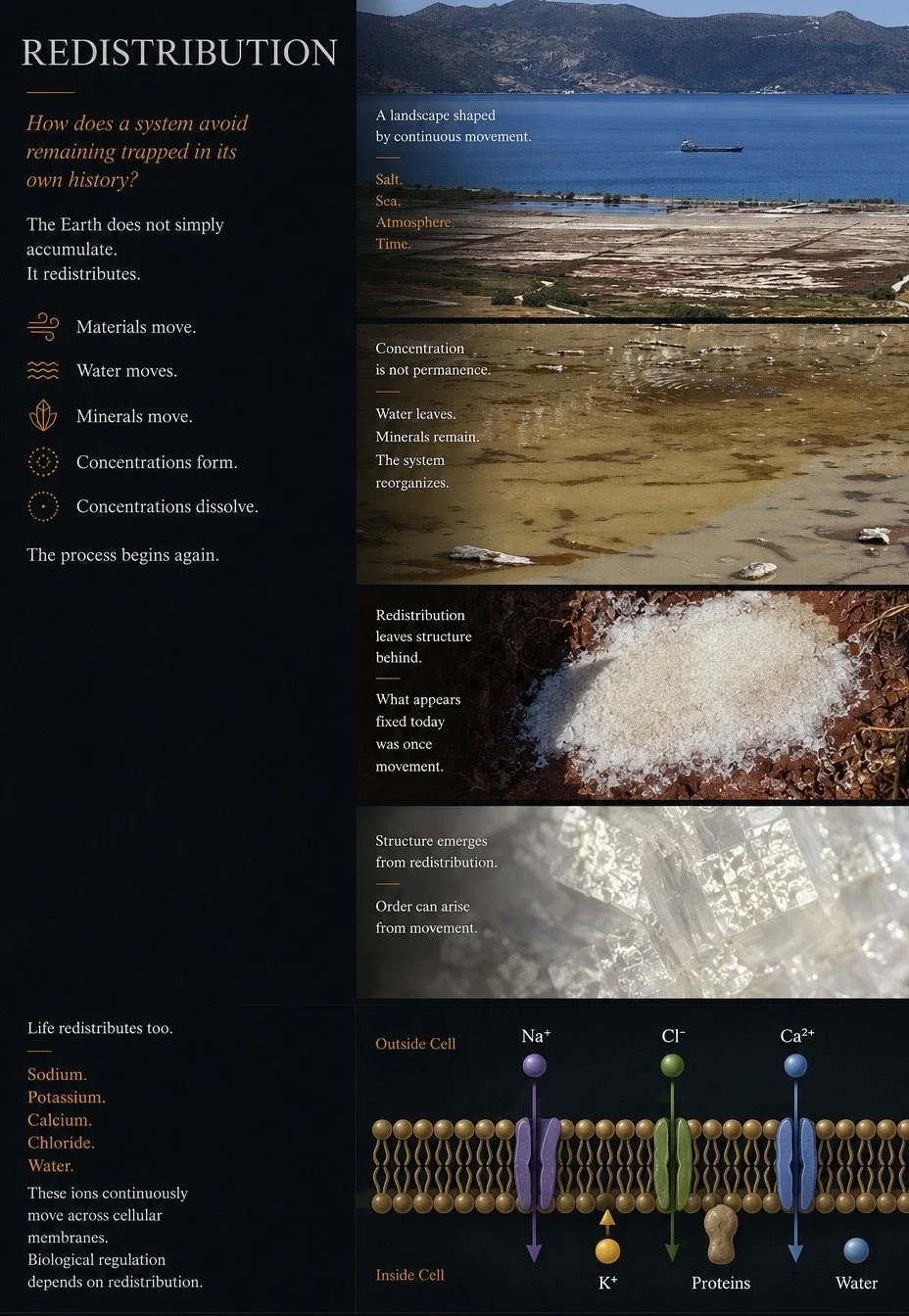
But hydrogen cannot move freely when carbon activation overwhelms mineral structure. Because excess carbon activation (from hydrophobic, carbon-rich stimulation) shifts signaling into fat–membrane domains, where minerals and water are excluded.
Without mineral scaffolding and hydrated pathways, hydrogen can’t shuttle charge freely—so protons get trapped locally instead of circulating to complete the signal. So the system stays “on.” Reset becomes shallow. Rest becomes unreachable. Sleep becomes fragmented. Presence disappears. The organism compensates by seeking more stimulation — not because it wants pleasure, but because it is searching for completion. This is addiction. Not attachment to substances. Attachment to unfinished biological energy.
Perception under carbon saturation
When mineral geometry is restored and hydrogen can discharge, perception becomes spacious. Thought slows. Images become clear. Attention widens. But under chronic methyl–carbon exposure, perception becomes compressed:
more thoughts
more urgency
more inner noise
more imaginary futures
more pressure to act
Modern consciousness is not accelerated because humans evolved. It is accelerated because carbon chains bypass geometry. We live inside an unfinished field.
Addiction and many chronic diseases are two expressions of the same collapse
Addiction is the behavioral expression. Chronic illness is the physiological expression. Both arise from the same mechanism: carbon stimulation without geometric completion. Both represent trapped activation. Both are attempts of the organism to resolve what has not been allowed to finish.
The Black Hole of Addiction
How Internal Gravity Pulls Us Into Repetition
By “internal gravity,” this work does not mean literal gravitational force like planets. It means a felt, directional pull inside the organism that emerges when activation builds up and cannot discharge. It is “gravity” in the same way we say “a problem has gravity” or “I’m drawn to it” — but here the pull has a real biological basis.
In biology, a living system is always trying to do two things: to keep internal variables in safe ranges (energy, temperature, glucose, oxygen, arousal, electrolytes, and more), and to resolve deviations quickly by returning to baseline. When something pushes the system away from baseline and it cannot return, the body treats that as an unresolved error. That unresolved error creates direction — toward relief, toward completion, toward discharge, toward something that previously reduced the discomfort. That direction is what this work calls internal gravity. It is not a belief and it is not a thought. It is a vector: a pull toward a particular solution.
When stimulation arrives faster than completion, nervous system arousal stays elevated, muscle tension remains partially “on,” stress hormones do not fully settle, attention keeps scanning, sleep becomes lighter or fragmented, and appetite, craving, irritation, and restlessness increase. This is stored activation. Stored activation behaves like pressure in a closed system, and pressure always seeks an exit. As a result, the organism begins prioritizing whatever gives quick release. That priority feels like compulsion, urgency, “I need it,” and narrowing of options. That narrowing is the gravity well.
A key feature of addiction is not just pleasure — it is salience. When a substance or behavior has repeatedly produced relief or a strong state shift, the brain learns, “This is a reliable exit.” Cues such as the smell of coffee, a cigarette pack, or a phone notification begin to grab attention automatically. The body starts preparing before conscious decision — through anticipatory tension, mouth watering, or agitation — and thoughts circle back to the same object. This is why the pull feels external, as if “it calls me,” even though it is internal. Attention is being curved toward the learned exit, like light bending around a massive object — a metaphor for the effect, not literal physics.
A black hole grows stronger as it gains mass, and internal gravity becomes stronger as it gains its own biological “mass.” This mass consists of accumulated unresolved signals, meaning unfinished activation stacking day after day; conditioning strength, meaning how consistently the substance or behavior has relieved; cue density, meaning how often triggers such as phones, cafés, stressors, or social environments are encountered; and system fatigue, meaning that when sleep, nutrition, mineral balance, and recovery are low, baseline is already unstable and the system falls into the well faster. As these factors build, the pull increases even if the pleasure decreases. Early on, the experience is “I want it,” which is pleasure-seeking. Later, it becomes “I need it,” which is relief-seeking. Gravity is strongest in this later stage.
Using the black hole language, the event horizon of internal gravity is the point at which choice stops feeling available. This is not because morality is lost, but because the nervous system flags urgent correction as needed, the body prioritizes the fastest correction pathway, and alternatives such as rest, calm, or patience begin to feel impossible or even threatening. This is why someone can sincerely say, “I don’t want to do it… and I’m doing it.” Their narrative self is no longer in control of the pressure field.
As addictive energy grows, freedom collapses. Early on, stimulation feels optional. Later, it feels necessary. This is not a moral change. It is an energetic one. Internal gravity narrows perceived options, shortens the pause between impulse and action, and makes rest feel inaccessible. The system prioritizes whatever provides the fastest discharge, even when the conscious mind no longer wants it.
Freedom requires space between impulse and action. Internal gravity collapses that space by increasing urgency signals, narrowing attention, increasing discomfort in the not-doing state, and making the chosen exit feel like the only tolerable path. The collapse of freedom therefore means fewer perceived options, a shorter pause before action, and less ability to tolerate discomfort long enough for completion to occur naturally. This is why willpower fails: willpower is a top-down tool trying to override a bottom-up pressure system.
Restoring timing changes this dynamic. Timing restoration means the body regains its ability to complete cycles: activation rises, action happens, discharge occurs, and return to baseline follows. When completion returns, internal gravity weakens because pressure no longer accumulates, relief is no longer possible only through the substance or behavior, and cues lose their emergency signal. The pull no longer needs to be fought as much, because there is less pull.
In lived experience, internal gravity feels like narrowing, where only one thing seems to work; urgency, where it feels like now and not later; automaticity, where movement toward the behavior is already underway; and relief-seeking, which is not joy but release. That is the signature.
The Core Principle of the Discharge Program
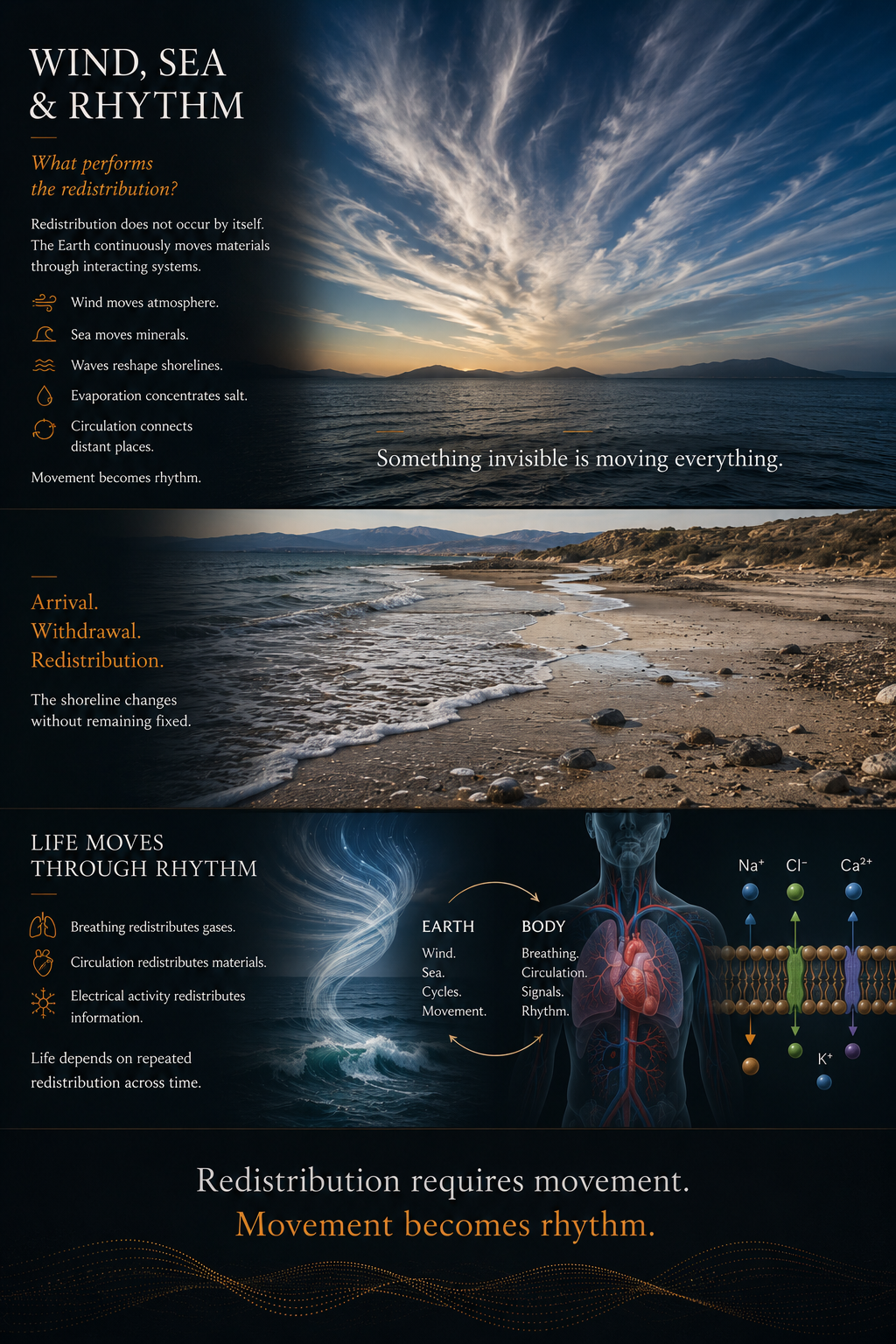
Energy in living systems is designed to circulate, stabilize, and complete.
When completion pathways are open, activation moves outward through balanced directions and returns to baseline. But when completion fails, symmetry breaks. Flow collapses into curved trajectories. Circulation becomes spiral repetition. Pressure builds. What once moved freely begins to pull inward.
This same pattern appears in vortices, drains, nervous systems, and gravitational systems.
In this work:
Octahedral coordination means stable containment with circulation.
Spiral means collapse of circulation into inward repetition.
Black hole means extreme spiral where exits vanish.
In simple terms:
When completion pathways close, multidirectional flow collapses into spiral repetition.
This program exists to restore those pathways.
Dormant People is a three-volume biological framework that answers how, where, and why addiction forms — redefining it as collapse of biological timing, not a substance problem, not excess desire, and not personal weakness.
What this work establishes
• Addiction as collapse of biological timing — not a substance problem
• Dependency as survival physiology — not personal failure
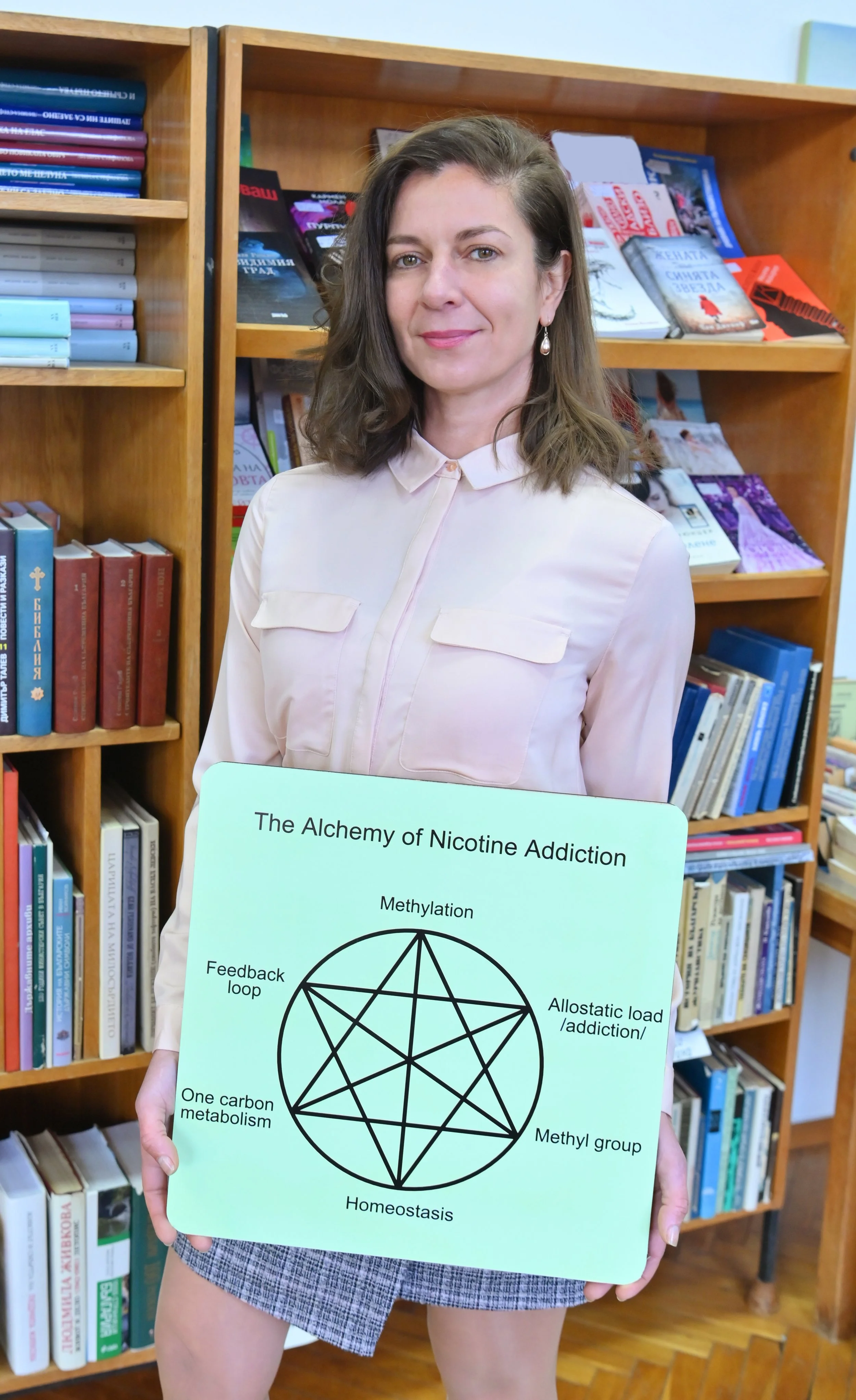
• Methylation as the chemical driver of modern overstimulation
• Homocysteine as a diagnostic signal of synthetic load and metabolic collapse
• Chronic illness and addiction as expressions of the same unfinished biology
• Matrix space as the missing structure required for completion
• Healing as becoming — not recovery, but entry into new biological coherence
Addiction is not excess desire — it is a loss of receptivity.
Read a glimpse below
The Home of Addictive Energy
Stimulants promise energy.
But what they deliver is activation without completion.
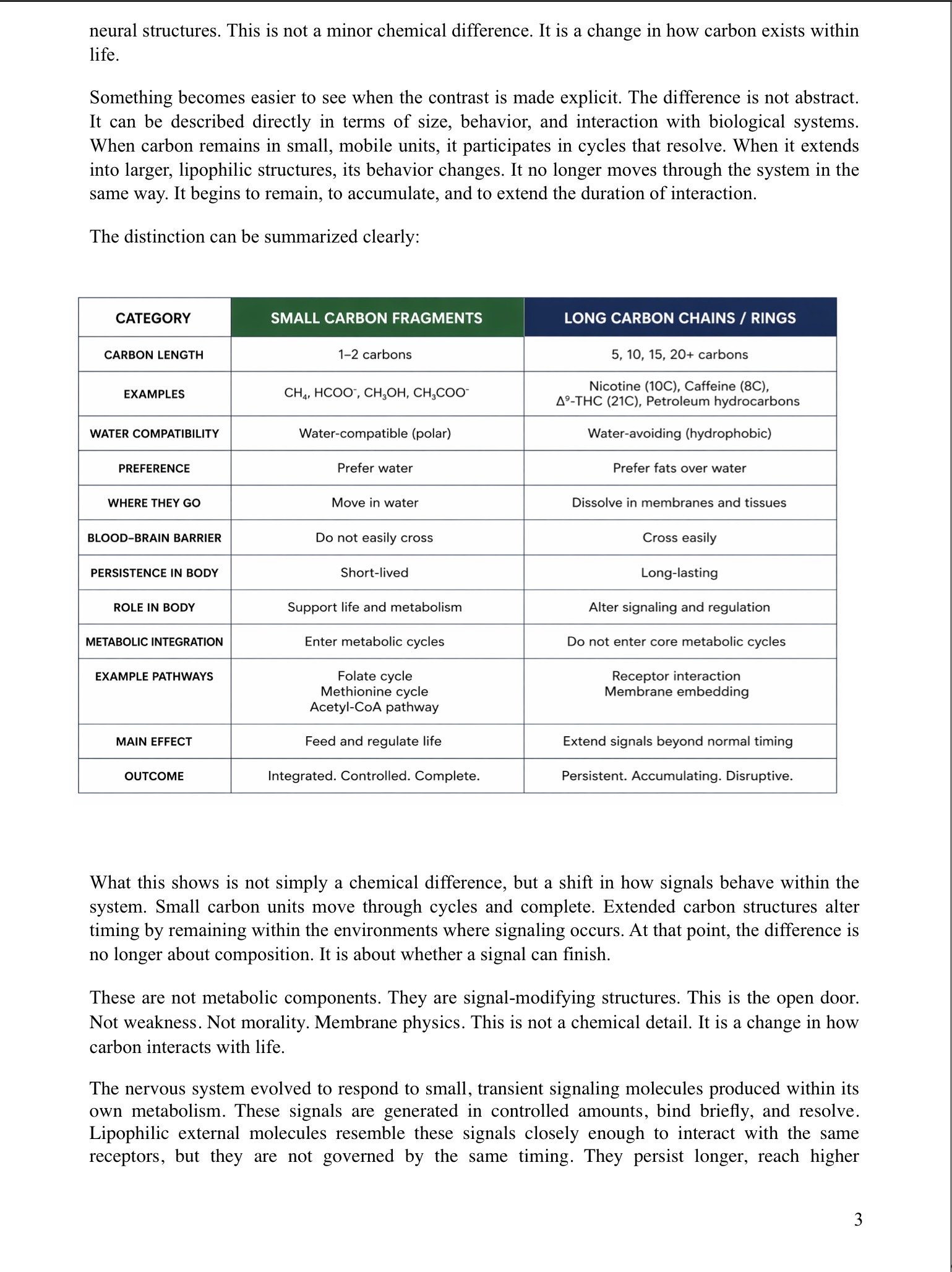
Across caffeine, nicotine, antidepressants, cannabis, and modern pharmaceuticals, the same small chemical signal appears again and again. It sparks the system — but leaves the body without a place to settle that energy.
What truly matters is where that signal lands.
This work uncovers the biological difference between energy that nourishes and energy that overstimulates — not through mindset, discipline, or willpower, but through chemistry, minerals, and timing.
If stimulation has ever felt powerful but empty, this is why.
The Ancestral Chemical Conditions of Addiction
Addiction and control are not cultural accidents.
They arise from an ancient biological memory system built on methylation — a chemical mechanism that stores experience, regulates genes, and repeats stimulation.
What is the Industrial Methylation?
THE CHEMISTRY OF AMPLIFICATION
A single methyl group can make a molecule faster, stronger, and harder to release.
Industrial chemistry learned this early: methylated compounds cross the blood–brain barrier more easily, last longer in tissue, and intensify neurological impact. Small chemistry. Massive leverage.
Natural Methylation - the Biological Update System
Methylation continuously adjusts gene expression, metabolic timing, and neurotransmitter balance — including serotonin, dopamine, and histamine — in response to experience.
It is the mechanism through which stress, environment, and nutrition are translated into cellular change, allowing signals to resolve and the nervous system to return to baseline.