The Deep Origin of Addictive Molecules
Excerpt from the book The Architecture of Addictive Energy by Irena Boycheva
We have been given many explanations for addiction. Most begin in the brain. These explanations describe what happens after a molecule enters us. They do not explain why certain molecules are capable of entering us and altering regulation so precisely in the first place. That is the deeper question. Nicotine, caffeine, cannabinoids, alcohol — we speak of them as substances with effects. But structurally, they are carbon architectures. And carbon did not begin in tobacco fields or coffee plants. It began in the Earth.
On the early planet, long before forests or nervous systems existed, water moved through volcanic rock. In processes such as serpentinization, water reacted with ultramafic minerals and generated hydrogen. In alkaline hydrothermal systems, this hydrogen met carbon dioxide across iron–sulfur and nickel–sulfur mineral surfaces. Under those conditions, carbon dioxide did not remain inert. It was reduced into small organic fragments.
In the late twentieth century, chemist Günter Wächtershäuser demonstrated that iron and nickel sulfide minerals under hydrothermal-like conditions could generate activated carbon compounds, including sulfur-bound methyl intermediates. Later, geochemist Michael Russell and colleagues showed that natural proton and redox gradients in alkaline hydrothermal vents could drive the reduction of carbon dioxide into simple organics such as formate, acetate, and methanethiol — small methyl-bearing molecules capable of transferring carbon fragments.
These were not complex substances. They were small, reactive carbon units. Life did not invent this chemistry. We inherited it. When early Earth chemistry reduced carbon dioxide (CO₂), it produced very small carbon fragments. Examples:
Methane (CH₄) → 1 carbon
Formate (HCOO⁻) → 1 carbon
Methanol (CH₃OH) → 1 carbon
Acetate (CH₃COO⁻) → 2 carbons
These are small. Water-compatible. Reactive. Easy to move through metabolic cycles. In biology today, these small carbon units:
Enter the folate cycle
Enter the methionine cycle
Produce SAM (S-adenosylmethionine) for methylation
Feed the acetyl-CoA pathway
This is carbon that feeds and regulates life. It is integrated. It is controlled. Now something changes when carbon chains become longer. When carbon atoms connect into chains or rings:
5 carbons
10 carbons
15 carbons
20+ carbons
They become hydrophobic (water-avoiding). Hydrophobic molecules:
Prefer fats instead of water
Dissolve in membranes
Cross the blood–brain barrier
Persist longer in tissues
Examples:
• Nicotine → 10 carbons, ring structure, contains methyl group
• Caffeine → 8 carbons, three methyl groups
• Δ⁹-THC → 21 carbons, highly lipophilic, multiple methyl groups
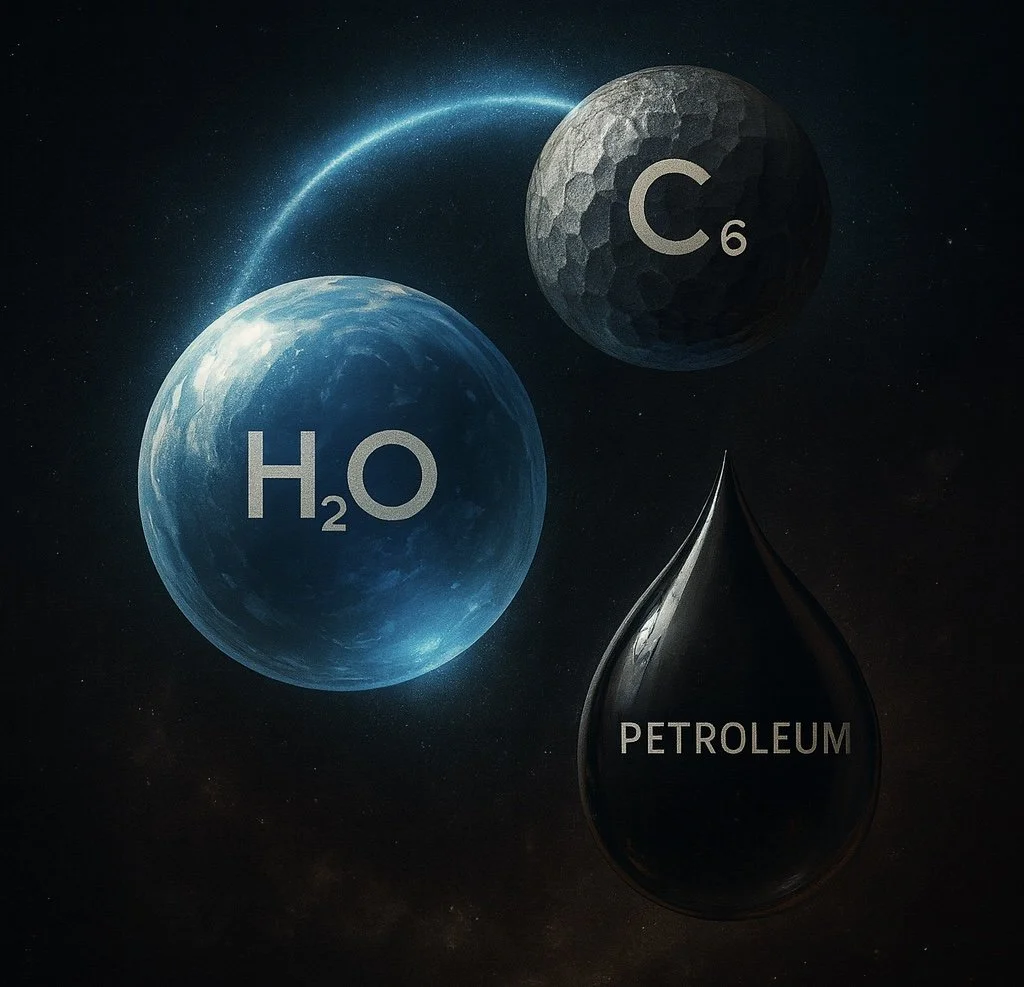
• Petroleum hydrocarbons → long hydrophobic carbon chains
These are not nutrients. They are signal-active structures. This is the open door. Not weakness. Not morality. Membrane physics.
Ancient carbon architectures meeting modern nervous systems. Our nervous system evolved to respond to small, transient signaling molecules produced within our own metabolism — acetylcholine, dopamine, serotonin, endocannabinoids. These molecules are generated in controlled amounts. They bind briefly. They are degraded. They resolve. They participate in cycles that complete.
Lipophilic plant alkaloids and synthetic derivatives resemble aspects of these internal messengers closely enough to bind to the same receptors — but they are not governed by the same internal feedback limits. They may persist longer. They may arrive in greater concentration. They may bypass gradual metabolic production controls. The nervous system is not weak. It is sensitive by design. Sensitivity allows learning, adaptation, and survival. But sensitivity also means that concentrated, membrane-permeable carbon structures can produce disproportionately strong regulatory shifts.
continue reading….