The Alchemy of Addiction
Original conceptual model developed by Irena I. Boycheva
An investigation into what lies behind the word addiction
In 2014, I began studying addiction with a question in my mind:
What energy is stronger than addictive energy?
I built a research library of medical and scientific references and began comparing mechanisms that are usually studied separately. I also began documenting biological markers through laboratory observations, including observations involving volunteers.
The investigation became experimental in the broadest sense: change something, measure what changes, and then ask what does not change.
This distinction became important.
In my observations, metabolic markers could change while the stimulation pattern remained. The numbers changed. The repetition remained. This forced me to look beyond the idea that addiction could simply be explained by a missing nutrient, a single neurotransmitter, or the presence of a particular substance.
I began looking for the structure connecting the processes.
The Alchemy of Addiction
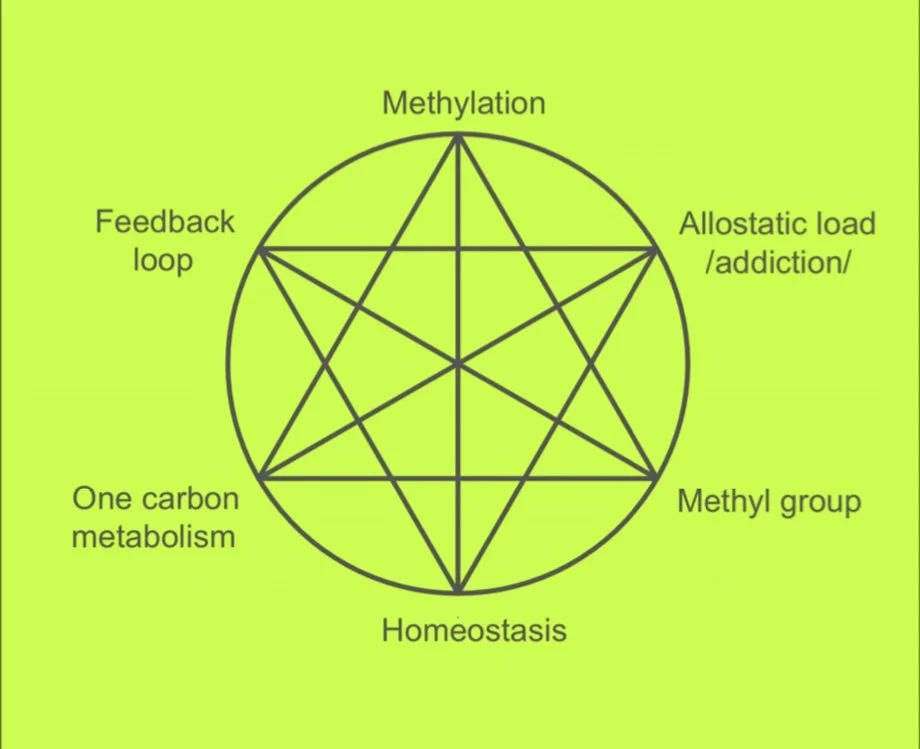
At a certain point in the investigation, I developed a diagram that I called:
The Alchemy of Addiction
It became an attempt to place the problem on one biological map — connecting allostatic load, homeostasis, feedback loops, one-carbon metabolism, methylation and the methyl group.
This diagram changed the investigation.
Because when I followed nicotine into its molecular and metabolic relationships, I kept encountering something remarkably small:
CH₃
One carbon.
Three hydrogens.
A methyl group.
The same small molecular structure appeared in compounds as different as nicotine, caffeine and THC. I did not conclude that the methyl group itself causes addiction — these substances act through very different biological mechanisms.
But its recurrence became a question.
Why does this tiny carbon structure appear again and again in molecules capable of changing the state of the human organism?
That question took me into one-carbon metabolism.
There, carbon was no longer simply part of a molecule. One-carbon units could be transferred, reorganized, added, removed and reused. Methylation participates in processes connected with gene regulation, neurotransmitter chemistry, membrane biology and metabolism.
And the investigation expanded again.
What I had initially called nicotine addiction began to look like a much broader problem of repeated biological activation.
I started comparing substances and products that humans use to change their state:
nicotine · caffeine · alcohol · THC · tea · cacao · energy drinks · processed foods · pharmaceutical compounds
The question was no longer simply:
What does this substance do?
It became:
What happens when repeated signals enter an organism whose biological systems must continuously transform, regulate and complete what those signals initiate?
The methyl group became one of the molecular clues in that investigation. I found that methyl-containing structures are widespread in pharmaceutical chemistry; the material I studied notes their presence in more than 67% of top-selling small-molecule drugs.
This did not prove that methyl groups cause addiction.
It revealed something more interesting:
The chemistry involved in changing human states is deeply connected to the chemistry by which the organism itself regulates and transforms those states.
From nicotine to addictive energy
Eventually, I needed a name for what I was seeing.
Because behind the word addiction, there appeared to be something more than the substance itself.
Something that could persist after the original signal.
Something produced through repeated transitions between biological states.
Something that could make the next signal easier to continue.
I called it:
Addictive Energy
By addictive energy, I mean the organization that can emerge when repeated biological activation remains unresolved and begins reorganizing the conditions for further stimulation.
The concept became the foundation of my first book:
The Architecture of Addictive Energy.
The book brings together mechanisms from physiology, neurobiology, biochemistry, endocrinology and systems biology and proposes a structural way of looking at addiction — not as one isolated mechanism, but as an organization developing across interacting biological systems and across time.
This is why the title is The Architecture of Addictive Energy.
Because I am not interested only in identifying the substance.
I am interested in the architecture that forms around repeated stimulation.
The investigation continues
The investigation eventually took me beyond the human organism and into the volcanic landscape of Milos.
There, I began following carbon, sulfur, iron, manganese, oxygen, thermal water, salts, gradients and mineral transformations — not as separate geological subjects, but as another way of investigating how matter moves, transforms and becomes organized under changing conditions.
Watch the Milos Documentary Investigation on the Dormant People Channel:
The same question remained:
What organizes the transition from one state to another?
Dormant People is the archive of this investigation.
It contains the research library, biological observations, diagrams, books and field investigations that have emerged from more than a decade of following one question.
I do not present the investigation as a finished scientific theory.
I present the evidence I have collected, the scientific literature that led me forward, the biological patterns I observed, the connections I developed, and the questions that emerged from them.