

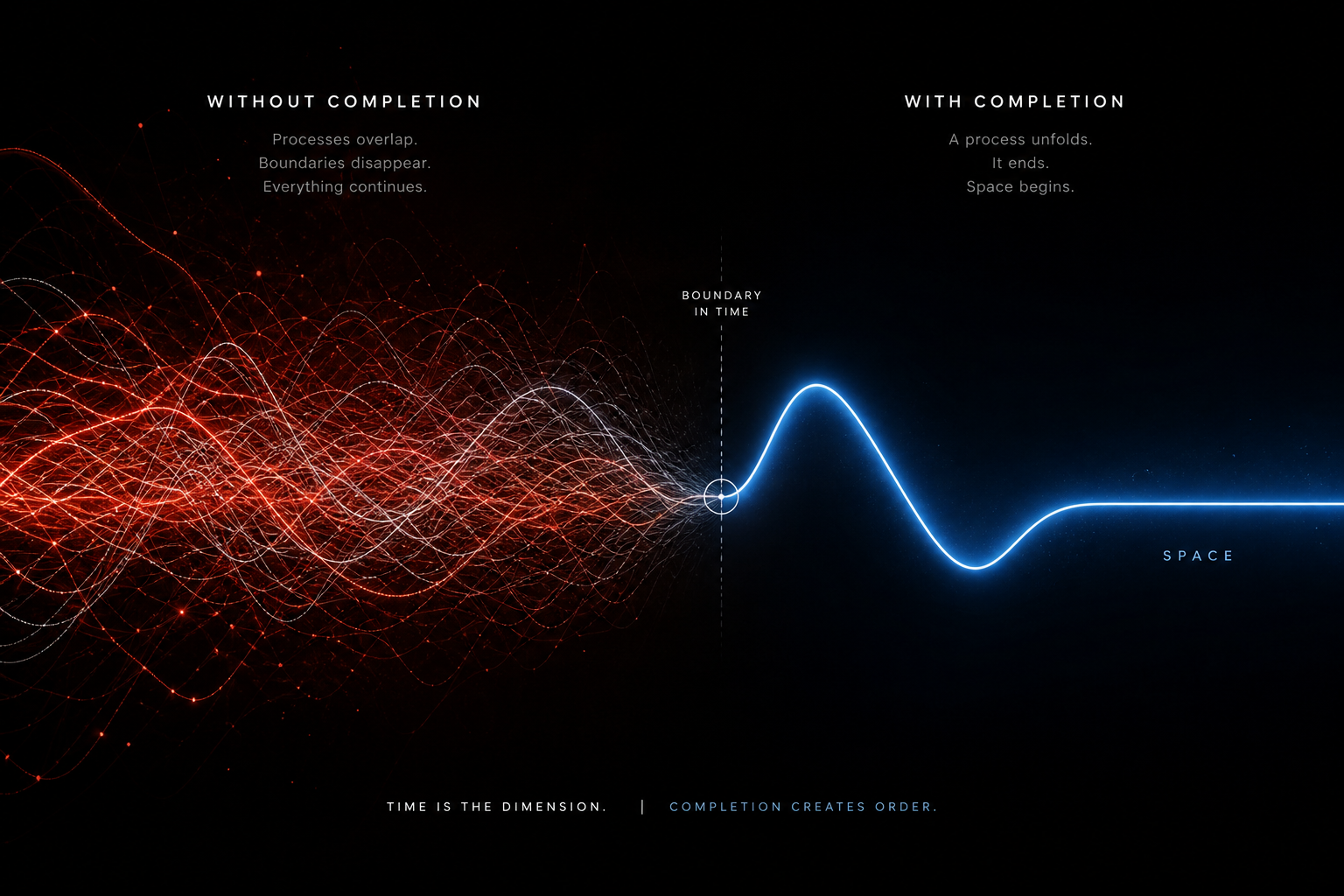
Time, Completion, and the Structure of Experience
We often speak about time as if it were something that moves around us. We say that time passes, that it flows, that it runs out. We feel pressured by it, chased by it, or left behind by it. But this way of speaking hides something more fundamental.
Time itself is not something we directly perceive. What we perceive is change. A wave rises and falls. A thought appears and disappears. A muscle contracts and releases. These are not experiences of time; they are experiences of change. Time is the structure we use to organize these changes to distinguish what comes before from what comes after.
Without change, time would have no meaning. There would be no sequence, no difference, no sense of movement at all. From this perspective, time is not what moves. Change moves. Time is how we describe the order in which change unfolds.
Every process in the body and in the world follows a similar structure. Something begins. It develops. And then it ends. This ending is not conceptual—it is physical.
A signal fades.
A contraction releases.
A chemical interaction resolves.
When this happens, the system returns to a more stable state. This is what completion is:
👉 the end of change
Completion is not simply the absence of activity. It is the restoration of a condition in which no previous process remains active. Only in this state is the system fully available for what comes next. And between the end of one process and the beginning of another, there is a transition point:
👉 a boundary in time
A boundary in time is not something we see. It is something that occurs when one process fully ends before another begins. It is the moment where change has stopped, and nothing new has yet taken its place.
This boundary allows separation.
It allows events to remain distinct.
It is what makes experience feel structured rather than continuous.
When processes complete and boundaries form, time becomes ordered. One thing follows another. There is clarity, sequence, and space. This is what we call a cycle: A process that begins, unfolds, ends and allows the next to begin.
Cycles depend on completion.
Without completion, there is no true cycle:
👉 only continuation
But when completion fails, something different happens. If a process begins but does not reach its end, it does not disappear. It remains active within the system. And if another process begins before the first has completed, the two do not remain separate. They overlap. One unfinished change continues while another is already unfolding.
When this happens repeatedly, boundaries in time begin to disappear— not because time itself has changed, but because processes are no longer completing within it.
Without completion, time cannot separate events. What would have been distinct moments becomes a continuous field of activity. This is the condition many people experience today, though they describe it differently.
They say there is not enough time.
That everything is moving too fast.
That there is no pause.
But what they are actually experiencing is not a lack of time.
👉 It is a lack of completion
Messages arrive before the previous one has been processed. Thoughts are interrupted before they resolve. Stimulation replaces stimulation. Emotional responses begin but are redirected before they can unfold fully. In each case, a process starts but does not end. And because it does not end—
👉 it continues
As these unfinished processes accumulate, the system no longer returns to baseline. There is no clear moment of release. No full deactivation.
No reset.
Instead, there is persistent background activity—subtle, continuous, and often unnoticed until it becomes overwhelming.
This is experienced as tension.
Not because something new has been added—
👉 but because what has already begun has not been allowed to finish.
In this condition, time begins to feel different. Not because time itself has accelerated— but because multiple unfinished processes are active at once. The density of change increases. The system carries more than one unresolved state simultaneously. And this density is interpreted as: pressure, urgency, or lack of time.
But the clock has not changed.
What has changed is the structure of experience.
Time does not create order on its own. It provides the dimension in which change can occur. Order arises only when change is allowed to complete.
It is completion that creates separation.
It is separation that allows sequence.
It is sequence that gives rise to the experience of time as structured.
Without completion, this structure collapses.
Events no longer stand apart.
They blend into one another.
The system remains in transition— never fully arriving at an end point.
And when nothing fully ends—
👉 everything continues
This is the deeper shift behind what is often called overstimulation. It is not simply that there is more input. It is that the conditions required for processes to complete are no longer present.
Without those conditions:
boundaries in time cannot form
cycles break down
the system cannot return to rest
What appears as a problem of time is, in fact, a problem of completion. Time remains available. But processes are not given the conditions to finish within it.
And so the question is not how to manage time more effectively— but how to restore the conditions in which change can come to an end. Because it is only at the end of a process that the system becomes free from it. Only there does separation occur. Only there does time regain its structure. Time is not what organizes reality. Endings are.