

Methylation was never designed to enslave life.
It evolved to stabilize it.
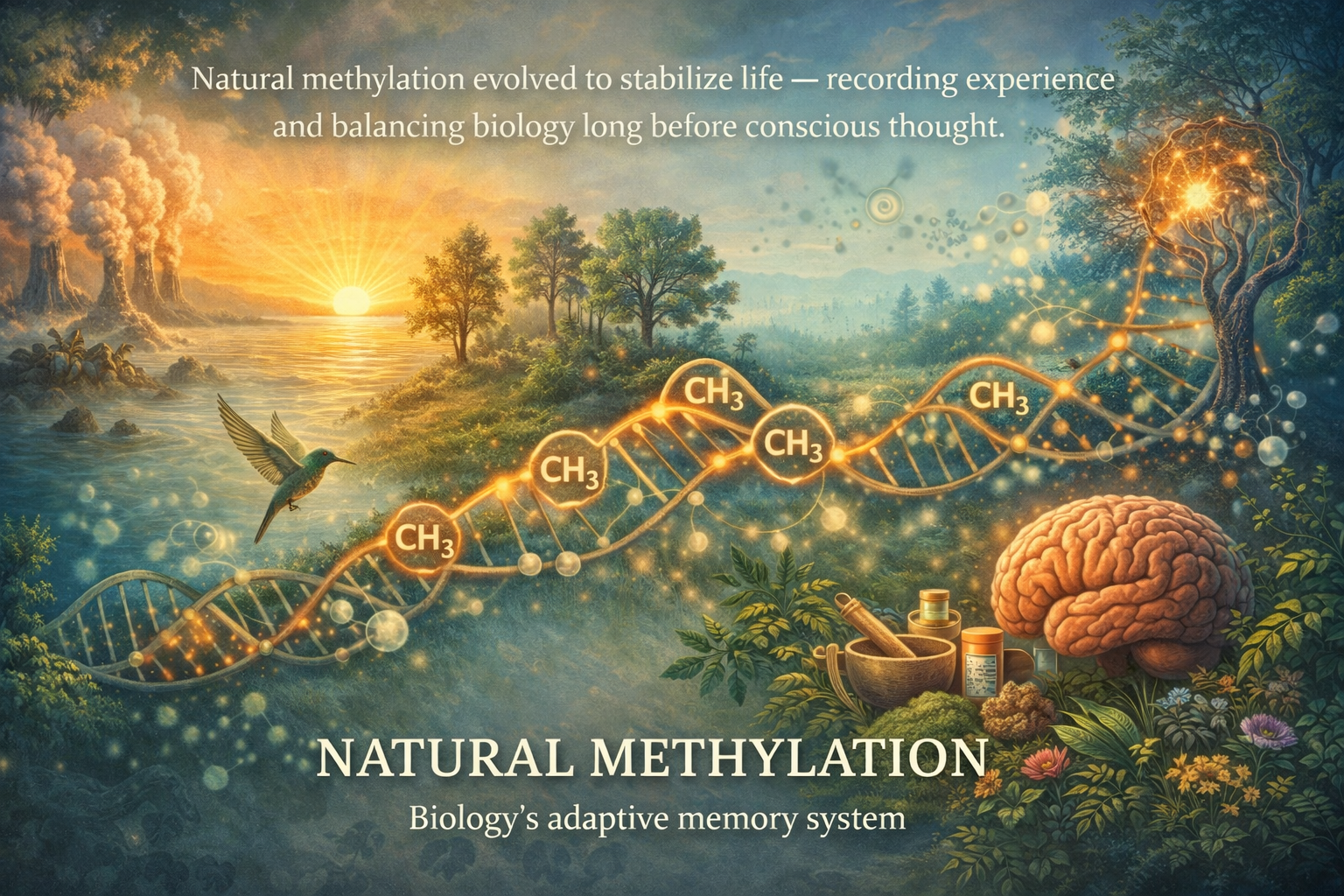
At its core, methylation is nature’s way of recording experience. A tiny chemical mark — one carbon, three hydrogens — tells a cell what to remember and what to let fade. It is how biology learns without thinking.
In the earliest forms of life, methylation meant survival. When cells encountered stress — heat, hunger, light, toxins — they marked their DNA, quietly storing the condition. The next time the same environment appeared, the cell responded faster, more efficiently. Over time, these marks accumulated, forming biological memory long before brains or nervous systems existed.
This is natural methylation.
Inside the human body today, the same process continues. Methyl groups are added to DNA, proteins, neurotransmitters, and hormones, subtly changing how they behave. Methylation does not create new structures. It modifies what already exists. It decides what is expressed and what is silenced, what is activated and what is cleared, what is held and what is released.
In this sense, methylation is the body’s epigenetic control system.
It determines which genes speak and which remain quiet — not by rewriting DNA, but by tagging it. This is how a liver cell stays a liver cell and a brain cell stays a brain cell, even though they carry the same genetic code. It is also how experience leaves a trace. Stress, trauma, nutrition, and environment can all shape these marks, writing life history into cells without conscious awareness.
Methylation also governs emotional balance.
Neurochemicals such as dopamine, serotonin, epinephrine, and histamine are regulated and cleared through methylation pathways. When this process is balanced, emotions rise and fall naturally. When it is disrupted, signals linger or disappear too quickly. Overstimulation and numbness are not opposites here — they are two sides of the same timing imbalance.
In this way, methylation acts as the volume control of the nervous system.
To perform this work, the body relies on internal carriers. The primary one is SAMe — a molecule synthesized from the amino acid methionine using cellular energy. SAMe transfers methyl groups where they are needed, allowing the system to function smoothly. This process depends on nutrients that support timing and transfer, drawn from food, environment, and metabolism.
Natural methylation is not a simple pipeline like digestion. It is a multidimensional process that quietly alters genes, proteins, and metabolism over time. Its patterns are shaped by diet, chemistry, stress, and surroundings — often without producing immediate symptoms.
This is why methylation is so powerful.
It does not announce itself.
It shapes who we become.