

The original methylation system — biological and cultural — was never meant to dominate life.
It was adaptive. Rhythmic. Precise.
Methylation evolved to create cycles: activation followed by rest, memory followed by renewal. It allowed organisms to respond to stress, then return to balance. Cultures mirrored this rhythm through rituals, seasons, fasting, celebration, and silence. Stimulation had an end.
Industrialization broke that rhythm.
With artificial light, constant noise, caffeine, nicotine, cannabis, petroleum-based additives, and now digital feedback loops, stimulation became continuous. The same neural circuits that methylation evolved to regulate were flooded without pause. What once turned on and then off was forced to stay on.
Where ancient systems gave the nervous system time to reset, the modern environment never stops. The result is biochemical rigidity. Methylation no longer supports flexibility; it begins to reinforce the same neural patterns again and again. Adaptation hardens into fixation. Survival chemistry becomes control chemistry.
This is where biology and economics merge.
The chemistry of repetition becomes the economy of repetition. Consumption, production, identity, and behavior all begin to follow the same loop: stimulate, respond, repeat. What was once sacred — a precise chemical spark — turns into a floodlight aimed directly at the nervous system.
This did not happen by accident.
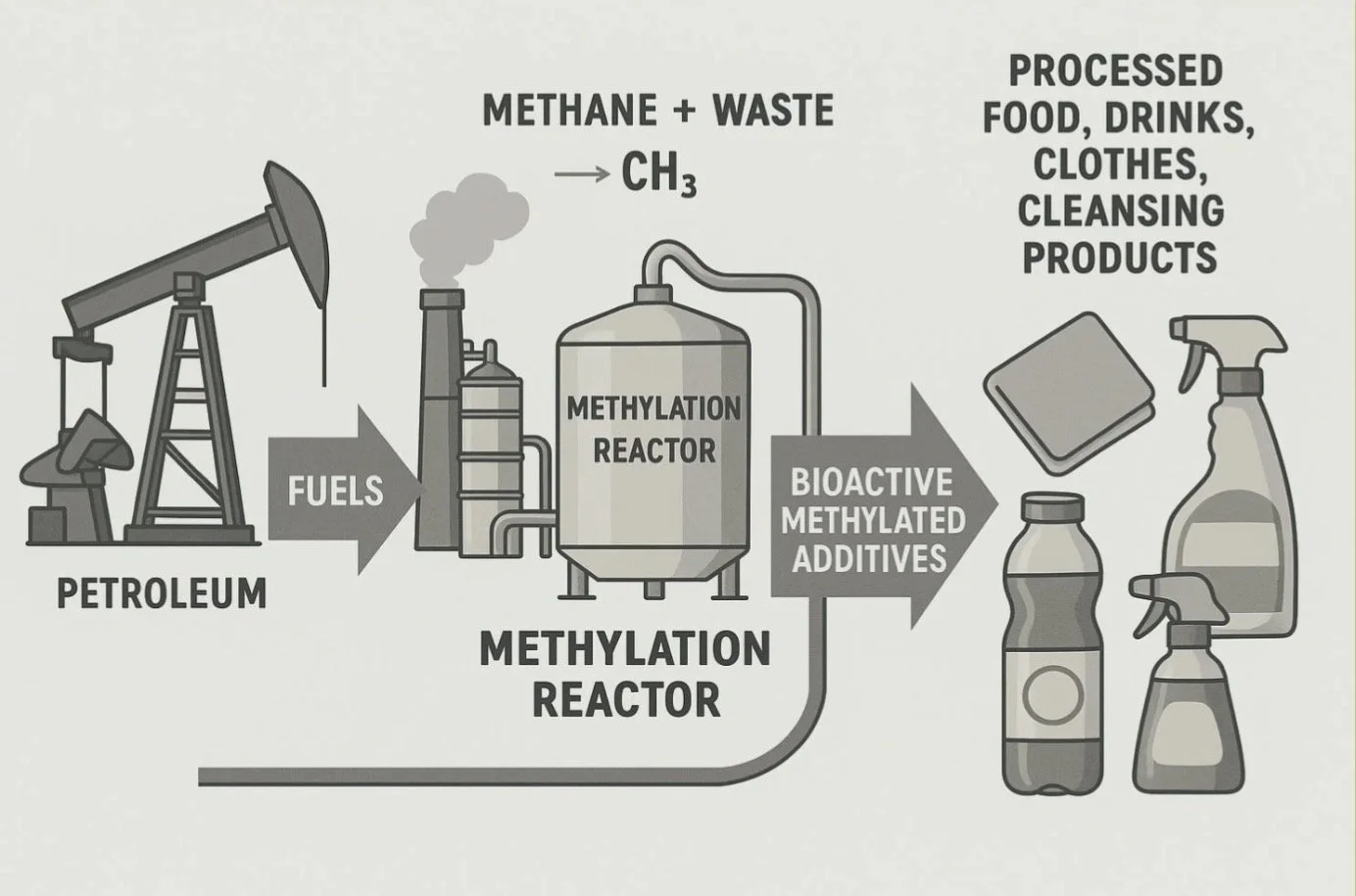
In the late nineteenth and early twentieth centuries, scientists began identifying methyl groups in natural stimulants such as caffeine, cacao, cannabis, and nicotine. Early chemists quickly discovered that adding a single methyl group could dramatically amplify a substance’s effect. Medicines became stronger. Dyes became more stable. Stimulants became more potent.
By the mid-twentieth century, this knowledge was fully industrialized. Pharmaceutical chemistry began engineering methylated compounds designed to act faster, penetrate deeper, and last longer in the body. From stimulants to antidepressants, anesthetics to opioids, methylation became a standard tool of enhancement.
The reason was simple: the methyl group is extraordinarily efficient.
With the addition of just one carbon, a molecule can cross the blood–brain barrier more easily. It becomes more lipid-soluble, more psychoactive, more persistent. It stabilizes products on shelves and intensifies their effects in the body. Methylation offered maximum impact with minimal material.
And stimulation sells.
As methylated compounds spread through food, medicine, and daily life, the human nervous system adapted the only way it could. Dopamine, adrenaline, and serotonin pathways were pushed into chronic activation. Over time, the brain reduced sensitivity. Stress became baseline. Anxiety blurred into numbness. To feel anything at all, stronger stimulation was required.
The loop tightened: stimulation leads to adaptation, adaptation leads to craving, craving demands more stimulation.
This is addiction by design.
Methylated compounds bind more strongly to receptors, making them harder to leave behind even when the original substance was mild. What began as chemistry became strategy. The same logic moved through food systems, pharmaceuticals, and consumer products — not to heal, but to retain attention and dependency.
The effects did not stop at the brain.
Synthetic methyl compounds interfere with hormone metabolism, histamine clearance, and liver detoxification pathways. Pain becomes chronic. Inflammation lingers. Recovery slows. The body carries stimulation long after it was meant to end.
Culturally, the pattern repeats everywhere industrial methylation goes. Sugar paired with caffeine creates artificial energy followed by collapse. Processed foods generate fatigue and craving. Pharmaceuticals manage symptoms without restoring timing. Stimulants become temporary identities rather than tools.
Across the globe, cultures are becoming chemically unified — not by language, tradition, or belief, but by the same methylated consumption loops.
The deeper pattern is unmistakable.
Nature used methylation to adapt, remember, and regulate. Industrial systems use it to stimulate, sell, and dominate. We replaced the wisdom of biochemical memory with the illusion of permanent activation. We no longer remember. We only react.