From Signal to System
Human civilization did not begin with ideas, it began with signals
From The Architecture of Addictive Energy
We do not live in a culture of choice. We live in a culture of repeated signals. Most of what appears as behavior—desire, motivation, productivity, consumption—follows patterns that were not consciously designed. They emerge from biological systems attempting to resolve activation that has not completed.
When completion fails, repetition begins. When repetition stabilizes, it becomes structure. And when structure scales, it becomes civilization.
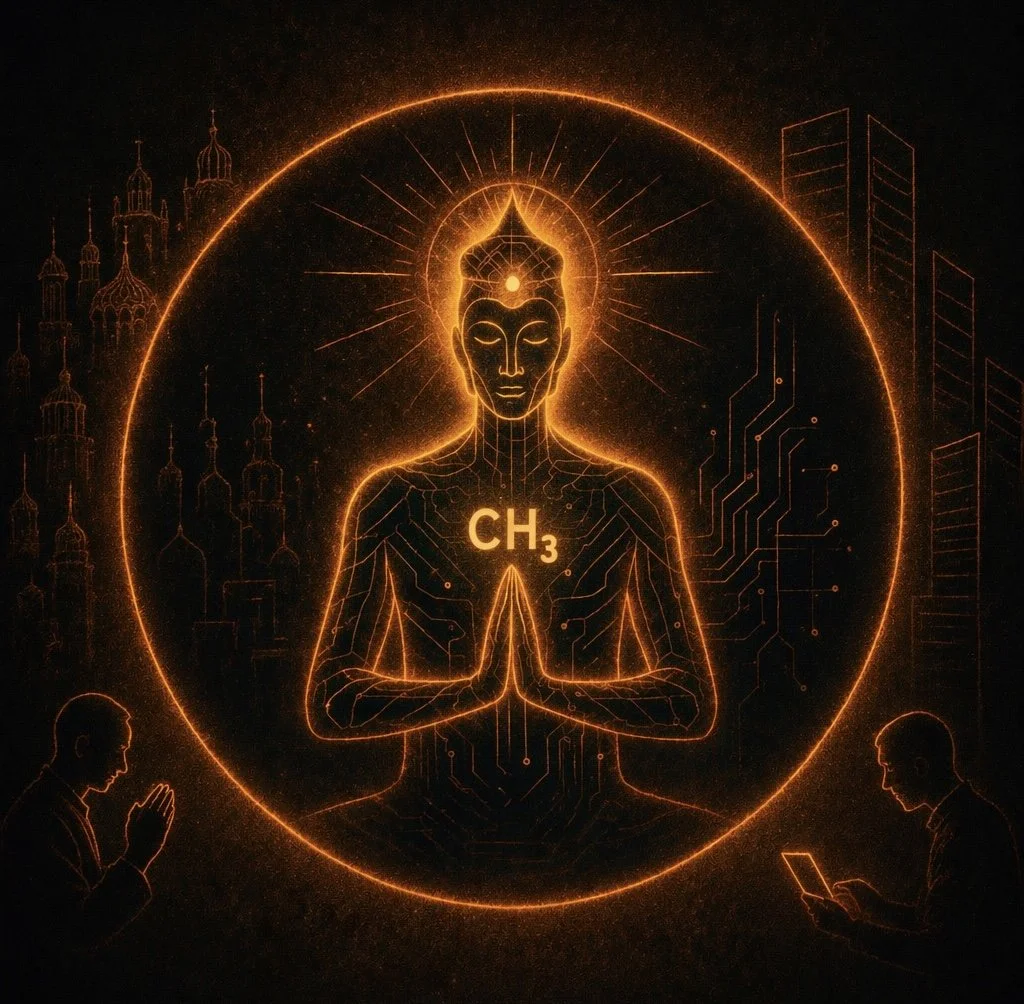
Before life began, the elements that would one day form the building blocks of biology were already present. Carbon, hydrogen, and other atoms that make up the methyl group (CH₃) were forged inside stars through the process of nuclear fusion. When these stars exploded in supernovae, they scattered their elemental contents across the cosmos. This cosmic dust eventually gathered into planets—including Earth.
Long before life, the chemistry of methyl groups was already forming in the interstellar medium. The methyl group existed in space, suspended in the debris of stars, waiting to participate in something more complex.
At the origin of life on Earth, methylation became central. The methyl group is a core unit in amino acids, nucleotides, and lipids—the essential ingredients of all living cells. The process of methylation, in which methyl group (CH₃) is attached to molecules like DNA or proteins, is one of the first known regulatory systems in biology. Through methylation, early cells learned how to turn genes on and off, how to respond to changes in their environment, and how to adapt.
In essence, methylation was the original language of life. It brought instructions to molecules. It activated biology. It made matter “know” how to behave.
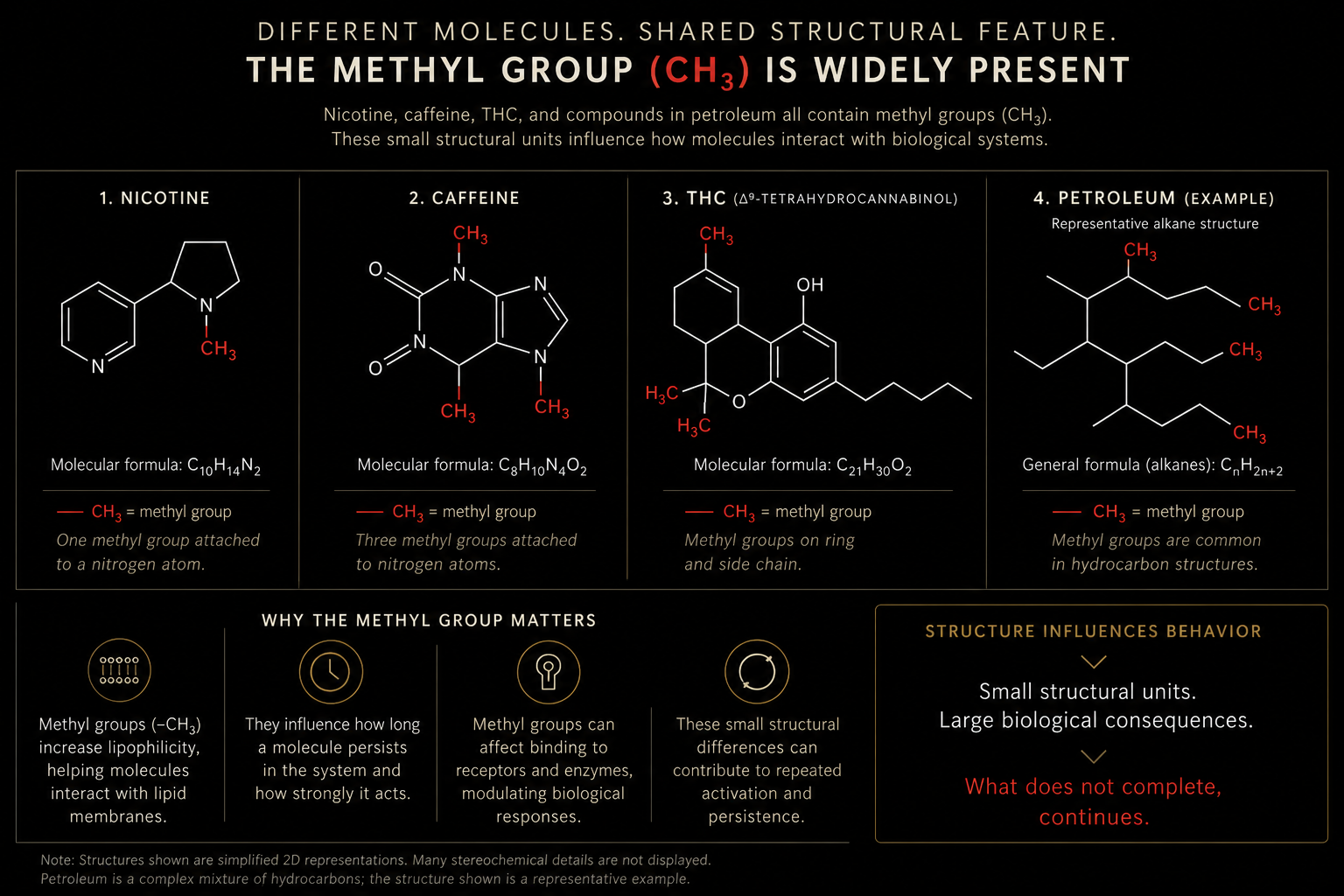
As life evolved, brains emerged—and with them, new forms of chemical signaling. The brain evolved to respond to specific molecular signals. Some of these signals involve structures that include methyl groups, which influence how molecules interact with receptors and membranes.
Substances like caffeine, nicotine, THC, and the neurotransmitters dopamine and serotonin all function through methylation pathways. These chemical signals shape emotions, attention, memory, and motivation.
Molecular structure influences how signals are transmitted and modulated within the nervous system.
……
Small chemical variations, including methyl groups, can alter how strongly and how long signals act. This was never a conscious decision—we were shaped by these dynamics.
With the rise of civilization, this ancient chemical loop became industrialized. Agriculture, trade, and empire were often fueled by methylated stimulants: tea, tobacco, sugar, cocoa. Later, the Industrial Revolution ran on fossil fuels—long chains of methylated hydrocarbons. As chemistry advanced, the same methyl group (CH₃)-based logic was applied to pharmaceuticals, plastics, food additives, fuels, and synthetic fabrics.
Even our modern digital culture mimics the methylation loop through fast-paced attention bursts, addictive apps, and dopamine-driven design. Civilizations rise when the methyl signal surges—more fuel, more food, more stimulation. They decline when the signal fades—through burnout, overstimulation, or scarcity.
You are reading a fragment.
The system continues in the book.