

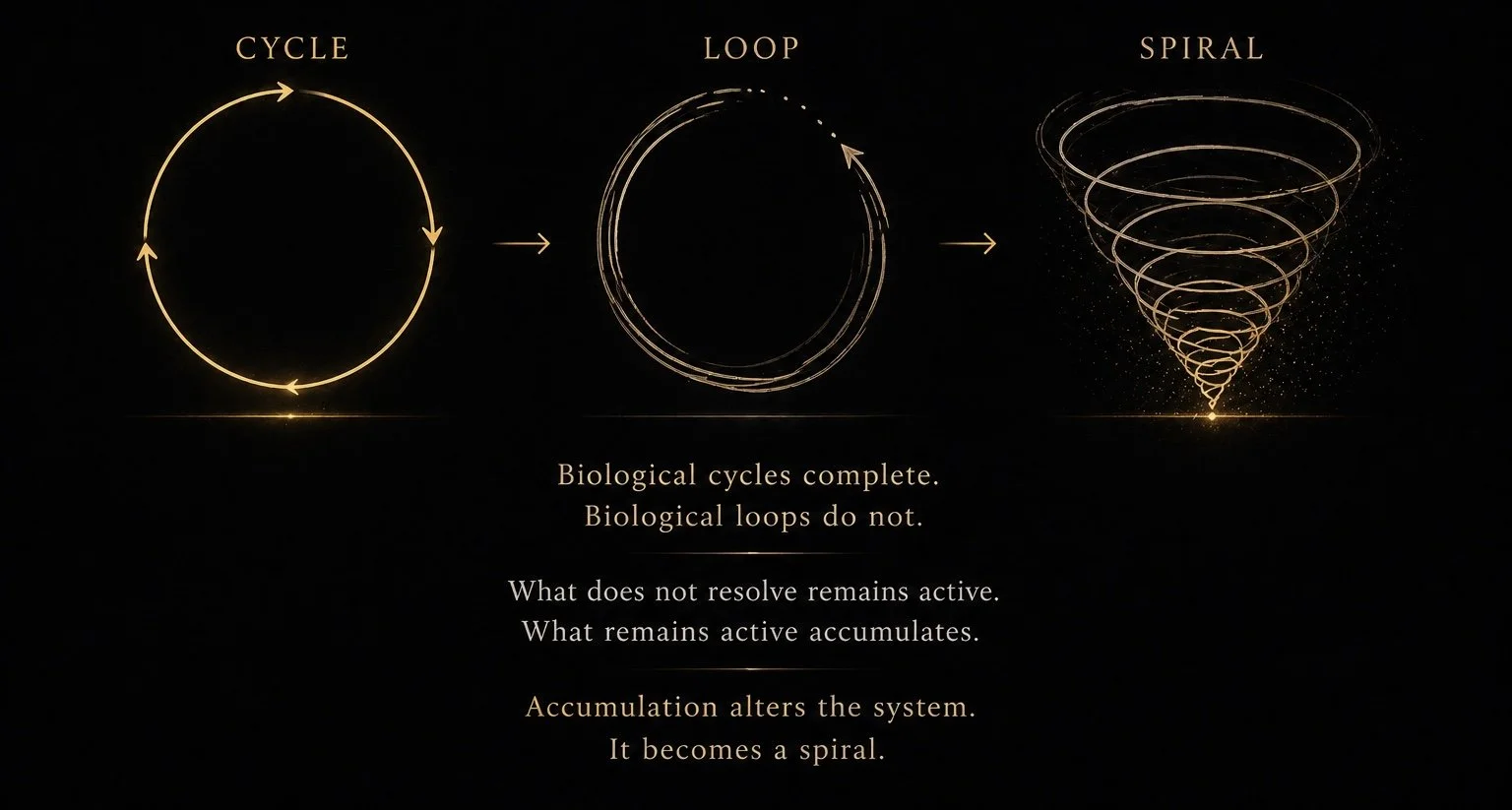
Addiction and Disease as Incomplete Biological Loops
Living systems are not designed for endless stimulation. They are designed for completion. Every biological activation follows a sequence: signal, mobilization, response, resolution, and return. Completion is not optional. It is the condition that allows the next cycle to begin. This sequence forms the foundation of physiological regulation. Without completion, physiology cannot stabilize, perception cannot settle, and behavior cannot organize coherently.
When a stimulus enters the organism — physical, emotional, or environmental — the body prepares. Energy rises, attention narrows, muscles tighten, and the nervous system shifts toward readiness. This mobilization is adaptive. In healthy physiology, however, mobilization is temporary. After the response is completed, regulatory systems return the organism toward baseline. When this return does not occur, the organism remains inside the response. Activation persists. Stress hormones remain elevated longer than necessary, neural circuits maintain readiness, and muscular tension does not fully resolve. Instead of closing the physiological arc, the system remains partially open.
What was meant to be a temporary state becomes a sustained one. This is the physiological context in which addiction emerges. Addiction does not begin simply as pleasure or weakness. It begins as continuous adaptation. The body begins to stabilize within a response that was never meant to persist. Repetition stabilizes the organism inside unfinished activation. In this sense addiction is not the opposite of adaptation. It is adaptation that has lost its endpoint.
Biology operates through cycles. Metabolic pathways regenerate their starting molecules so reactions can continue. Respiration cycles oxygen and carbon dioxide. Cardiac rhythms alternate contraction and relaxation. Sleep cycles restore neural activity. Hormones are secreted in pulses, and neural networks oscillate between excitation and inhibition.
Life maintains itself through closure. When closure fails, loops emerge. Activation does not fully resolve. Muscular tone remains slightly elevated, stress hormones decline more slowly, and neural circuits maintain readiness. The organism experiences internal tension that has not completed its natural arc. Because sustained tension is difficult to tolerate, the system begins orienting toward stimuli that previously reduced it. This orientation appears psychologically as craving or compulsion. Beneath the psychological experience lies physiology: the cycle has not finished. A loop is not repetition by choice. It is a cycle that has lost its endpoint…..
You are reading a fragment.
The system continues in the book.